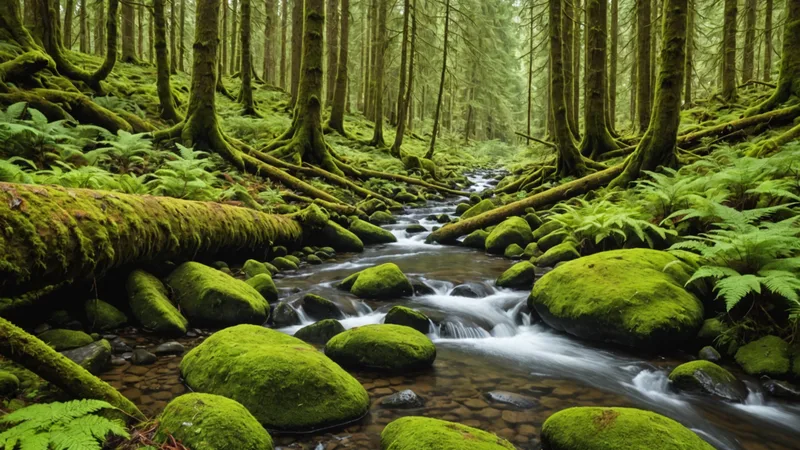
In March 2025, we completed the first eDNA sampling campaign at our inaugural enrolled site — a 47-hectare riparian corridor in the northern Oregon Coast Range, managed by a family land trust that had been undertaking active restoration work since 2022. This post documents what the data showed, where the site sits in its recovery trajectory, and what we learned about the relationship between restoration age and detectable species uplift.
Site Description and Restoration History
The site occupies a tributary drainage of the Nehalem River watershed, at an elevation between approximately 150 and 320 meters. The primary restoration interventions prior to our baseline enrollment included removal of approximately 12 hectares of non-native invasive species (primarily Himalayan blackberry, Rubus armeniacus, and reed canarygrass, Phalaris arundinacea), replanting with native riparian understory species (sword fern, salal, red alder), and passive channel recovery after the removal of a failed fish-passage culvert in early 2023.
The land trust had maintained records of vegetation surveys since 2022, which provided useful contextual data for our baseline — though those surveys were vegetation-only and lacked any faunal assessment beyond occasional opportunistic bird observations. Our eDNA campaign was the site's first systematic biodiversity assessment.
Sampling Design and Field Methods
We established five water-column sampling stations along a 1.8-kilometer reach, positioned to capture the upstream reference condition, two mid-corridor restoration zones, the culvert-removal reach, and a downstream reference point. At each station, we collected triplicate 1-liter water samples using sterile 60mL syringes, filtered through 0.2-micron polycarbonate track-etched membrane filters in the field within four hours of collection, and preserved filters in Longmire's preservation solution for transport to our processing laboratory.
Field blanks (laboratory-grade deionized water processed through the full field protocol) were collected at every station. No detections from target species were recorded in any field blank, confirming field contamination controls held throughout the campaign.
Concurrent with eDNA sampling, we deployed two AudioMoth devices — one at the upstream reference station and one in the central restoration zone — for a seven-day continuous recording period. Acoustic data was processed against our standard Pacific Northwest riparian acoustic model, computing ACI, NDSI, ADI, and BIO indices at 10-minute intervals across the recording window.
Species Detections: What the eDNA Showed
Sequencing recovered 47 unique ASVs (Amplicon Sequence Variants) mapping to confirmed vertebrate taxa across the five stations. Key detections included:
- Coastal cutthroat trout (Oncorhynchus clarkii clarkii) — detected at all five stations, with highest eDNA concentration at the culvert-removal reach. Consistent with expected recolonization following improved passage connectivity.
- Pacific giant salamander (Dicamptodon tenebrosus) — detected at three of five stations in the mid-corridor restoration zones. A reliable presence indicator for high-quality cold-water riparian systems in the Coast Range.
- Tailed frog (Ascaphus truei) — detected at the upstream reference station and one mid-corridor station. Ascaphus truei has extremely restricted dispersal capacity and requires cool, well-oxygenated, undisturbed stream substrates; its detection suggests the upstream conditions are meeting habitat quality thresholds necessary for retention.
- Columbia torrent salamander (Rhyacotriton kezeri) — single detection at the upstream station. This species is an Oregon Department of Fish and Wildlife Species of Special Concern; its presence elevates the conservation significance of the site and will be tracked closely in subsequent campaigns.
Macroinvertebrate eDNA was recovered from 12 families across EPT (Ephemeroptera, Plecoptera, Trichoptera) orders — the biotic index families most sensitive to stream quality. The EPT richness estimate of 12 families is consistent with a high water quality stream in a recovering riparian system, though below the reference condition of 16–18 EPT families typical of intact old-growth Coast Range tributaries.
BHI Baseline Score and Interpretation
Based on the March 2025 campaign data, we assigned the site a provisional BHI score of 61 / Provisional. This score reflects:
- Species richness component (weighted 40%): 0.68 — vertebrate detection profile is good for a 3-year restoration, below reference for old-growth corridor
- Acoustic diversity component (weighted 30%): 0.72 — NDSI values indicate biological sound dominating the soundscape at both recorders; ACI at the restoration zone is 18% above our regional degraded-corridor reference value
- eDNA completeness component (weighted 30%): 0.58 — EPT detection below reference, reflecting incomplete invertebrate community recovery
A score of 61 places this site in the Provisional tier (50–69 range), which is appropriate for a site with demonstrable biodiversity value that has not yet reached the community completeness levels required for Verified tier (70–84). The EPT gap is the primary factor holding the score below the 70 threshold.
Restoration Trajectory Assessment
What the data tells us about where this site is headed is arguably more important than the baseline score itself. The detection of Ascaphus truei and Rhyacotriton kezeri — both species with low dispersal capacity — suggests the upstream reference reach is functioning well enough to retain sensitive specialists, which is a positive indicator for downstream recovery. The high cutthroat eDNA signal at the culvert-removal reach is consistent with rapid recolonization following passage restoration, a pattern well-documented in Pacific Northwest fish passage literature.
Our projection for the next annual campaign (March 2026) is that EPT family richness should increase by 2–4 families as hyporheic zone conditions continue to improve post-culvert-removal disturbance. If that projection holds, the site should cross the 70-point threshold into Verified tier, making it eligible for credit issuance at a higher valuation tier. We will publish those results when they are available.
The March 2025 campaign also established a critical methodological baseline for this site: we now have a documented species matrix and acoustic reference profile against which all future monitoring will be assessed. The value of that baseline — rigorously collected, field-blank-controlled, and archived with raw sequence reads — compounds over time as the restoration record accumulates.