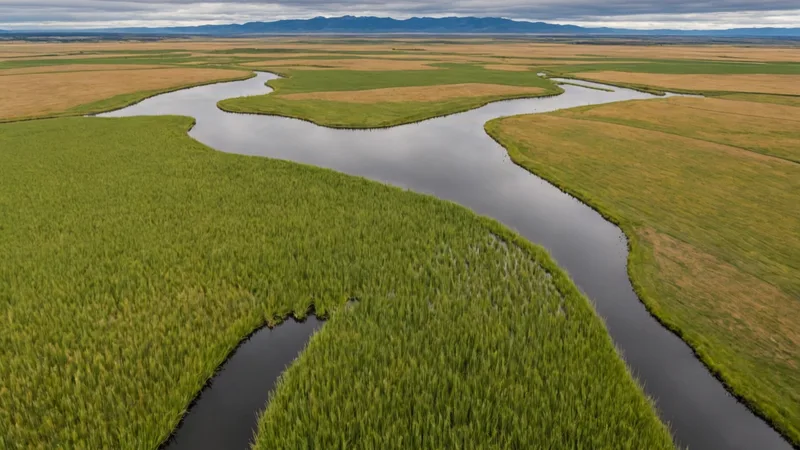
In September 2025, we completed the baseline BHI assessment for a 340-hectare wetland complex in the southern Willamette Valley — a site characterized by a mosaic of emergent sedge marsh, seasonally flooded pasture, open water, and remnant riparian woodland along a tributary of the upper Willamette. This is the largest site by area we have enrolled to date, and the species data it produced presented both expected findings and several that complicated our initial modeled expectations.
Site Context: A Restored Agricultural Wetland
The site was converted from row crop agriculture to wetland restoration beginning in 2018, under a conservation easement held by a regional land trust. The restoration involved reestablishment of seasonal flooding through berm construction and water control structures, removal of existing tile drainage, and replanting of emergent vegetation in the shallower basin areas. By the time of our baseline assessment, the site had been in active restoration management for approximately seven years — long enough for primary wetland functions to have re-established but still within the successional window where community assembly dynamics are active.
Willamette Valley wetland systems are among the most ecologically significant in the Pacific Northwest for migratory waterfowl, shorebirds, and wetland-associated herptofauna — notably including the Oregon spotted frog (Rana pretiosa), which has experienced dramatic range contractions through the valley due to agricultural conversion and wetland drainage. The baseline assessment was specifically designed to determine whether R. pretiosa or other wetland specialist species were present or colonizing the site.
eDNA Sampling Design for Wetland Systems
Wetland eDNA sampling requires protocol modifications compared to our standard riparian stream approach. In lentic systems, eDNA does not behave as a transported signal along a flow gradient — instead, it disperses radially from source organisms, stratifies vertically with water column thermal structure, and can accumulate in sediment boundary layers. This means that longitudinal sampling station placement (appropriate for streams) needs to be replaced with spatially distributed sampling across the wetland basin.
For this site, we established eight sampling stations distributed across the major habitat units: three in the emergent marsh, two in the open water areas, two at the edge of the seasonally flooded pasture zone, and one at the riparian woodland fringe. At each station, we collected surface water (approximately 20 cm depth) and near-sediment water (approximately 5 cm above the sediment surface) as paired samples, given the expected stratification of herptofauran eDNA concentrations near the bottom of shallow wetland habitats.
Bioacoustic recorders were deployed at four stations, with particular attention to dawn and dusk recording windows during the site's spring breeding period (we ran a pre-enrollment acoustic monitoring pass in April 2025 specifically to characterize the anuran chorus).
Species Detections: Key Findings
The full detection matrix included 62 vertebrate ASVs assignable to confirmed taxa, making this the most species-rich site in our enrollment portfolio by vertebrate count. Notable detections included:
- Oregon spotted frog (Rana pretiosa) — detected at two emergent marsh stations and the near-sediment sample at the open water margin. This is a significant finding: R. pretiosa is listed as Threatened under the US Endangered Species Act and as Critically Imperiled (S2) in Oregon. Its presence at the site substantially elevates conservation significance and the credit valuation ceiling for this enrollment.
- Great Basin spadefoot (Spea intermontana) — detected at the seasonally flooded pasture stations. An ephemeral-wetland specialist that uses the flooded pasture areas for spring breeding; detection is consistent with the seasonal flooding regime established by the restoration water control structures.
- Western pond turtle (Actinemys marmorata) — eDNA detected at the open water station. While the Willamette Valley historically supported pond turtles, confirmed populations are fragmented and the species is a Species of Concern in Oregon. Confirmation of eDNA presence warrants follow-up visual surveys to establish population size and status.
- American bittern (Botaurus lentiginosus) — acoustic detection in April pre-enrollment survey and confirmed as resident by eDNA detection in September baseline. Bitterns are rigorous wetland quality indicators and their year-round presence is consistent with a fully functional emergent marsh.
Waterfowl and shorebird detections were numerous and expected: mallard, Northern pintail, dunlin, long-billed dowitcher — the standard assemblage for a restored Willamette Valley wetland in September migration season. These detections are ecologically valuable but do not drive the BHI score significantly given their wide range and relatively non-specific habitat requirements.
Acoustic Index Results
The September acoustic data showed notably high BIO (Bioacoustic Index) values at the emergent marsh stations — consistent with the high amphibian eDNA signal and the dense acoustic activity we observed during the April breeding season survey. NDSI values were uniformly high across all eight stations, indicating the site is acoustically remote from significant anthropogenic noise sources. This is partly a function of landscape position — the site is 4 kilometers from the nearest significant road — and partly a function of the emergent vegetation structure providing acoustic shielding.
ADI values were highest at the riparian woodland fringe station, reflecting the greater diversity of bird species using the woodland-wetland edge habitat compared to the open marsh interior. This edge-habitat acoustic signal is a consistent pattern in our Willamette Valley wetland data: the highest acoustic diversity occurs at the transition zones between wetland types, not in the interior of any single habitat unit.
BHI Baseline Score and Enrollment Pathway
Based on the September 2025 baseline campaign, we assigned an initial BHI score of 74 / Verified. The score reflects:
- Species richness component (40%): 0.82 — elevated by the R. pretiosa and A. marmorata detections; the ESA-Threatened and state S2 species presence creates a multiplier on the richness component under BHI scoring rules
- Acoustic diversity component (30%): 0.78 — strong BIO and NDSI values offset by moderate ACI relative to our highest-scoring riparian sites
- eDNA completeness component (30%): 0.61 — invertebrate community eDNA was less complete than expected, likely reflecting limited benthic macroinvertebrate colonization in the younger restored areas of the basin
A score of 74 places the site solidly in the Verified tier (70–84), making it immediately eligible for credit issuance. The R. pretiosa detection will also trigger a premium species flag in our credit data schema — credits from this site will carry the ESA/S2 species designation as a disclosed attribute that buyers can reference in their TNFD disclosures. The pathway to Premium tier (85+) is plausible within 2–3 annual monitoring cycles if invertebrate community completeness continues to develop as the older restored areas mature.